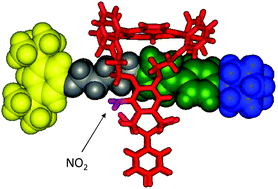
The development of synthetic catalysts that has parallel enzymatic efficiency in terms of rate and turnover is still a challenge in chemistry. The de novo design of a biochemical system in a molecular matrix is fascinating and challenging for future synthetic catalysis. We recently used a non-covalent interaction approach to create nano-sized artificial enzymes for the size, shape, stereo, and enantio-selective synthesis of small molecules and polymers.
Monday, December 24, 2018
Artificial polymerases
Monday, October 13, 2014
Supramolecular Chemistry in Drug Discovery
Contributing writer Lily Bryant
Supramolecular chemistry has important medical applications, as it aids the development of new drug therapies by helping researchers to understand how medications interact at the target binding sites in the body. This area of chemistry has also aided the development of binding drugs that are able to alter the target substance and its properties, so the substrate is unable to reach its action site or trigger the usual biological response. Examples of this are the phosphate binding drug sevelamer hydrochloride, which is used to manage raised phosphate levels in advanced cases of chronic kidney disease, and the selective binding agent sugammadex, which reverses neuromuscular block brought on by vecuronium and rocuronium during anesthesia. However, supramolecular chemistry is also important for the development of drug delivery systems, which offer encapsulation and targeted release.
Researchers from Lawrence Berkeley National Laboratory have recently made a development that will hopefully pave the way to more effective and safer drug delivery systems. These systems can help to reduce the unwanted side-effects associated drug therapies, which are sometimes severe enough to discourage patients from accepting medication or mean that they have to abandon treatment. As with opiate based painkillers, the untargeted nature of their actions means that some drugs may even lead to addiction. While intrathecal delivery of painkillers can help those people struggling with chronic pain that is difficult to control, it isn’t without its risks and more precise targeting of drugs with the aid of molecular delivery systems could offer more successful results without the adverse effects.
The team which previously
developed peptoid nanosheets that come together where air and water meet have
now created peptoid nanosheets that come together where oil and water meet.
If you are not familiar with the concept of a peptoid nanosheet, this is a
synthetic 2D protein structure, which typically has a thickness of just three
nanometers, making it one of the thinnest organic 2D crystalline materials
available. Just like natural proteins, peptoids are able to fold and curve into
specific shapes, enabling them to complete precise functions. As it is possible
to customize the peptoids from which they are formed, this makes the properties
of these nanosheets flexible, meaning that they are a good candidate in the
area of drug delivery. Additionally, the very large surface area of peptoid
nanosheets makes them ideal for sensing and recognition, which is again vital
for drug delivery. Another useful property for these applications is
their hydrophobic core, which excludes water molecules, meaning that peptoid
nanosheets have the potential to carry hydrophobic cargos, as demonstrated by
research published in ACS Nano. Finally, peptoids are
not as sensitive to chemical or metabolic changes as proteins, so they are less
likely than natural proteins to break down, which is advantageous when using
them within the body.
The latest findings, which were published in the September edition of the Proceedings of theNational Academy of Sciences USA, show how it is possible for these specific and highly organized peptoid sheets to form at a water-oil interface. Spectroscopic measurements confirm that the monolayers are extremely well ordered and that it is the electrostatic action between charged molecules on the peptoid that allow the formation of this orderly structure at the surface of oil and water. The ability to create these nanosheets using oil instead of air creates new possibilities for their production6. It would also allow the development of libraries of various functionalized nanosheets and allow screening for peptoid nanosheets that have the same molecular recognition as specific proteins, which would aid future drug discoveries. While the production of peptoid nanosheets with drugs in their interior is still some way off, these findings open up the possibility of extending the complexity and functions of 2D nanomaterials, which can only aid the development of drug delivery systems.
About Lily Bryant
About Lily Bryant
Lily Bryant is a writer working with one of only two licensed online pharmacies in the US. She is strongly interested in promoting and creating content aimed at relevant readers as part of her role in ethical healthcare business. She believes that it is important that we play a strong role in leading society towards a healthier lifestyle through the promotion of exercise and healthy diet rather than an early adoption of drug treatment.
Tuesday, September 23, 2014
Old wisdom new tools
Some of the shapes depicted in ancient artifacts that were invisible to the human eye came into view with the advent of 20th-century tools. Some being nano and microstructures. These tools also help chemists to see the formation of chemical bonds in real-time.
The rapid development of modern nano-technological tools such as the Atomic Force Microscope (AFM), Scanning Tunnelling Microscope (STM), and Laser Scanning Confocal Microscope (LSCM) allow scientists to invent, explore and validate old scientific discoveries. From the perspective of scientists involved with chemistry, it helps to manipulate atoms and molecules precisely for the fabrication of macroscale products as well as to look at the real-time covalent bond formation in a single molecule. Observing chemical reactions by force microscopy at sub-molecular resolution has been reported by de Oteyza et al. They reported the atomically resolved imaging of a complex molecule as it undergoes a chemical reaction on a metal surface.
In addition to the normal covalent bond formation, very recently Wilson Ho et.al., revealed the image of hydrogen bonding in porphyrin molecules using chemically modified STM tip, enlightening us with the rapid advance in this field. These developments will have a huge impact in nanoscience especially in the field of single molecular electronics and bottom-up fabrications. This new evolution of molecular nanotechnology will bring chemists, physicists, engineers, and biologists together.
How practical is it to prove old theories with modern, technologically advanced tools? Is it really possible? However, if it is indeed possible, would it be a landmark achievement that would push chemistry into a new era, in the coming years? Let me exemplify. Mayan blue is a bright blue pigment that had been used by Mayans about 2000 years ago to paint murals. The distinct feature about these murals is that the Mayan-blue has withstood the wrath of weather over centuries, and refuse to fade even to this day. on the On the other hand, even the most advanced of paints of today, tend to wear off after a couple of years of harsh weather and negligent maintenance. This is a phenomenon that has baffled scientists for several years. They were able to gain some insight into this in the recent past with the help of modern nanotechnological tools. The Mayan dye is based on Indigo dye, which is trapped in a porous fame work of clay called palygorskite. The silicate hull forms a protective layer around the dye molecules. This prevents the dye pigments from directly interacting with the forces of nature and other interferences such as organic solvents, acid, and alkali treatment, etc.
It is the Mayan's ingenuity at developing the pigments for Mayan blue that has set them eons beyond outreach. Reverse engineering could help us understand its structure and shed some light into the properties of advanced hybrid materials. Maybe, the day is not far off when we are able to decode this chemical phenomenon and come up with commercial paints that will last forever.
Saturday, October 5, 2013
Cooperative Catalysis
Cooperative catalysis occurs when the synergic catalytic effect of at least two different entities acts together, increasing the rate of a chemical reaction beyond what is possible when either of the two entities is used independently. The idea of “Cooperative Catalysis” has inspired synthetic chemists to create artificial dual activation catalysts. Such a Cooperative Catalytic pathway is often used in enzymatic catalysis. Enzymes are continue to be a source of inspiration for (designing and) developing new catalytic reactions that are high in efficiency & selectivity and minimal waste.
Urease is a dinuclear metalloenzyme which catalyzes the hydrolysis of urea into carbon-di-oxide and ammonia. The dimeric nickel center of this enzyme is (the active site) responsible for cooperative catalysis. Urea co-ordinates with one Ni-center, thus activate the electrophile (act as Lewis Acid), whereas water coordinates with the second Ni. It is thus acidified and can be deprotonated by histidine to generate hydroxide as a nucleophile (generate nucleophile), which is, now in close to the electrophile, and, can attack in an intramolecular fashion.
A similar cooperative catalytic activity with Bronsted and Lewis acidities can be generated by simultaneous incorporation of multiple elements in the silica framework is quite interesting and holds promises of unprecedented catalytic performances.
We recently prepared a similar natural mimic, a bimetallic nano-porous catalytic system, which would be able to perform cooperative catalysis for the selective synthesis of ortho-prenylated phenols and 2,2-dimethyl chroman, starting from phenol and allylic alcohol. Prenylated phenols are widely distributed in nature and are known to be an important structural unit of pharmaceutical compounds. Similarly, 2,2-dimethylchroman derivatives also exhibit broad range of interesting physiological properties, we are able to synthesis the important structural motif by using the new cooperative catalytic systems.
The amount of aluminum present in the framework dictates the acidity of the catalyst, and by fine-tuning the aluminum content, we can develop the catalyst with the desired catalytic property. Catalyst developed in such a manner was found to be highly active and selective. The products obtained were good and satisfactory. Additionally, the synergistic effect of the bimetals (Cu and Al) in the nanoporous catalysts controls the selectivity of the final products.
Thursday, October 3, 2013
Nobel Advice
Are you a Nobel aspirant, young researcher, or want to be part of good science? Here is an advice from Prof. Avram Hershko ( Winner of 2004 Nobel Prize -for the discovery of ubiquitin-mediated protein degradation)
Here is a lesson from his life in science that he presented at the Lindau Nobel Meeting 2013."
- It is very important to have good mentors- you cant learn how to do good science just from reading the literature.
- Find an important subject that is not yet interesting to others the big guys will get there before you! Do not go with the mainstream.
- Accidental observations may be the most important ones. Grab your Luck.
- Use whatever experimental approach is needed for your objective. It may not necessarily be the most fashionable (“state-of-the-art”) technology. Of course, biochemistry will always be needed.
- Science should be a curious driven adventure. You should have a lot of excitement and fun.
- Never leave bench work, and shall continue to get a lot of excitement and fun.
Subscribe to:
Posts (Atom)


_-_Nobel_Laureate_Avram_Hershko.jpg)